In
The Nursery/Seiben
Hallamshire Hotel, Sheffield - 22 June 2024
"One
of the best gig nights of my life"
The last
time In The Nursery played at The Hallamshire Hotel was sometime
during 1984. There was actually no Facebook event page for the
gig, possibly because the venue only has a capacity of about 100
and ITN knew it would easily sell out without one. The gig was
originally announced on
the ITN Facebook page on April the 15th - and although it
grabbed my attention immediately, I soon resigned myself to not
being able to go, due to my money situation. However, a month or
so later, I changed my mind, thinking "Sod it - I'm going to
go, even if I have to sleep in my car in one of the city centre
car parks!"... only to find out that the tickets had just
sold out by then! Gah!
So instead I
joined the waiting list for 'returns', even though I suspected it
would be pretty much in vain. In fact, I received an email, saying
"There's 20 people ahead of you on the waiting list", which
further tempered my expectations. However, on 31st of May I
received a message from Eventbrite that a ticket had come up for
me and I had 24 hours to claim it. I took it in about 24 seconds!
I resolved
to find myself a cheap AirBnB place for one night, rather than
drive 400 miles in a day. I was about to pull the trigger on a
place that had, frankly, substandard reviews, when I found out -
very belatedly - about Sheffield's 'CAZ' - their equivalent of
London's ULEZ. Since my car would therefore have caused me to have
to pay a further fee, I decided to look further out from the
centre... and I totally lucked out! I found a nice basement room
in a converted stables/barracks on Infirmary Road - just outside
the CAZ, with gated parking (never had that in my life before!),
very near the Infirmary Road tram stop and thus only 4 stops away
from the venue, on West Street! When I booked the place and the
owner told me that the gate code was '1961' - the same as the
title of one of In The Nursery's recent albums, I knew it was
meant to be!
 |
 |
So...
after a slightly fraught drive up, I actually arrived almost
perfectly on time at 16:00. As it happened, I walked into the
pub venue (more on that later) to find Nigel and Klive
Humberstone actually standing in front of the bar, chatting with
Dan Conway - creator of the visuals for them that night, plus
the likes of Wrangler
(whose T-shirt I had worn on the drive up, coincidentally),
Seefeel, Gazelle Twin and many others. I should perhaps have
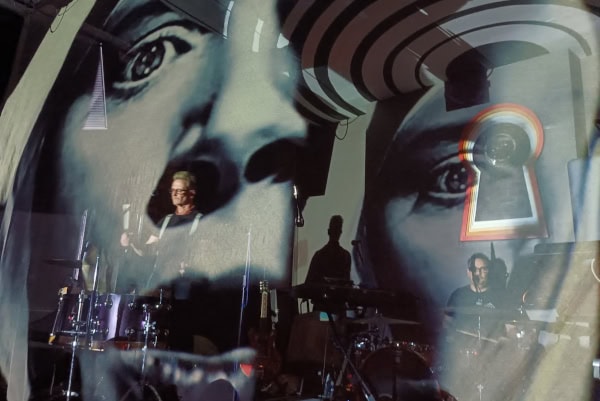
realised the Wrangler link, due to the multi-layered gauze screens used for projections at their
live events.
The upstairs venue filled up quickly, which was a good job, as Sieben - Matt Howden, who I also got to chat with briefly, afterwards - took to the stage not long after the doors opened. I have to admit that, when I saw Sieben announced as support, I had no idea who he was. I'd seen the name, but had never heard any of his music. So - like you do, these days - I visited Bandcamp and briefly listened to parts of a track or three. Although I enjoyed them, I wasn't blown away. Live, however, was a different matter entirely! I described him as "...a cross between peak Richard H. Kirk and Soft Riot, but with Blancmange's Neil Arthur on vocals ...plus screaming Metal viola(!)..." and for the most part, I stand by that. (I just ought to make it clear that my idea of "peak Richard H. Kirk" as it applies to this scenario is the early/mid-90s stuff, like 1993's Dark Continent under the Sandoz moniker through to the 2003 Bush Doctrine album by Biochemical Dread... just for instance!)
 |
 |
 |
You see, Matt Howden is a master of live
sampling and looping. He typically 'beatboxes' (yes!)
his own rhythms, maybe adds one or two sampled vocal
backing phrases, then pushes them into the background
by letting loose with what I can only describe as a
wall of 'Metal' viola/violin noise and singing the
full lyrics over the top of it all. Now, Kirk -
another Sheffield citizen, of course, and one of my
musical heroes, had his own way of sampling. His
samples were what most people would call 'rough and
ready' or 'primitive'. Frankly, it often sounded like
he had been recording Central African or Caribbean
radio on an old 1970s mono radio-cassette recorder and
had un-paused the cassette tape when he heard
something he liked, then hit the pause button again,
once that segment had ended ...and then he'd apply
that 'sample' to a track with no editing whatsoever!
Of course there was actually much more to it
than this (I think he had a couple of different Akai
samplers from the late 80s/early 90s at the very
least). But the important thing is that the editing
and 'polishing' of the samples was kept to a minimum.
This resulted in a 'rawness' that was often downright
funky - check out his track Covert Political Action Programme
under the moniker Vasco de Mento and you'll see
what I mean. In that example, every loop seems to be
not just raw, but also out of tune with the others
too, yet in the end they combine to create something
ineffably *funky*, for want of a better term. (Well...
it wouldn't be a Sheffield 'report' without at least
one Richard H. Kirk-based diversion, would it? 😉 )
Similarly, although Sieben's live approach to
looping and sampling is, if anything, far more
accomplished (and not out-of-tune at all, I should
emphasise!) that very process of sampling and looping
yourself live carries with it such an element of
jeopardy that it is always going to feel a bit
'rough'... and that is the very joy of it! I was blown
away not just by the live process but by the tunes
themselves in that live setting, particularly when you
add in that element of screaming electric ('Metal', as
I called it) electric viola/violin. I actually briefly
collared Matt in the bar area afterwards (buying one
of his CDs - Crumbs) and asked him whether it
was an electric viola or violin. He amazingly replied
that it was both! It has not 4, but 5 strings,
covering the octave range of both those instruments!
Throw in the fact that he was plucking as well as
bowing the instrument, all the time playing perfectly
in tune with the self-samples (plus twirling the bow
in the air) and I'd have to say he is a virtuoso of
that unique instrument. Overall, if you don't know
Sieben already, check him out... and in particular go
and see him live - it's a performance far more
memorable than my words or comparisons can do justice.
 |
 |
 |
But the real reason I was there was, of course, In The Nursery. I have been into ITN
since I discovered them on From Torture To Conscience
on Death In June's NER label, back in 1984. Yes, I was a
DIJ fan in my youth (I would have been 18/19.) I was so
taken that I've bought most things by ITN since. To be
completely honest, although I liked those two tracks and
1986's Twins albums, it was with 1987's Stormhorse
album that I was blown away and became truly enthralled by
their sound. I was already a fan of things like
4AD's Cocteau Twins and This Mortal Coil - the 'pretty
stuff', basically - and had always loved Ennio Morricone's
spaghetti western scores, plus those for Das Boot
by Klaus Doldinger and The Name Of The Rose by
James Horner - both recent at the time. So when Stormhorse
came along, it fitted right in with that pantheon, for me
and I played it on repeat.
Curiously, it seemed that I fell for each
alternate album the most, with 1990's L'Esprit,
1992's Duality, 1994's Anatomy Of A Poet
and 1998's Lingua being highlights from their
catalogue for me, the introduction of poetry as an element
of their songs furthering the appeal for the young(ish)
me. They would - seemingly simultaneously - later
start creating soundtracks for classic silent movies and
would also, with Jo Wingate, establish the Sensoria
festival of film and music (where I would finally see the
aforementioned Richard H. Kirk live for the first time, in
the now-demolished Grosvenor House Hotel on Charter
Square) as their standing in the international audiovisual
community grew. I saw the first of these - their
soundtrack for Wiene's 1920 The Cabinet Of Doctor Caligari
- performed live in North London - for a Halloween
screening at the Everyman Cinema. Their penchant for
situation-appropriate venues became apparent over the
years too: I would later see them perform their
soundtracks for Carl Theodor Dreyer's 1928 Joan Of Arc in Sheffield
Cathedral and that for Sidney Lumet's 12 Angry Men
in Sheffield Crown Court.
But fast-forward to the (almost) present day and
their most recent album - the eponymous Humberstone
sees them taking what feels like a step forward,
stylistically. It somehow feels like their most 'mature'
album yet, the theme of reflection and representing their
family's past proving fertile ground for the seeding of
new tunes and even in some cases whole new styles for
them. It's a beautiful work and should surely see them
taking their place among the pantheon of the likes of
Morricone, Zimmer, Badalamenti and their later peers,
Johan Johansson, Olafur Arnalds and Max Richter. The track
Cookham
Stone (The Painter) in particular I find so
moving I can barely listen to it. I tried listening to it
at work, last week, but had to turn it off as I was
instantly almost in tears. Similarly, last night - guess
what? - they started with that very track and I was
paralysed. I almost fell to the floor at first, similarly
overwhelmed. But, with my hand to my face and
surreptitiously wiping away the tears that ensued, I just
about made it!
 |
 |
 |
They immediately bounced from one end of their
back catalogue to the other, with Stone Souls,
from 1983's When Cherished Dreams Come True
drawing a rapturous response from the capacity
crowd. They latterly seem to have taken to the use
of the classic bass and guitar set-up, live, whereas many
of the earlier soundtrack performances I have previously
seen by them were necessarily synth and laptop based, and
the rest of their set - with this flexible new set-up -
was a jaunt through their copious four-decade long
back-catalogue. I suppose the Minimal Wave/Coldwave
revival may have had a little to do with the re-emphasis
on songs from their earlier catalogue, but ultimately who
cares, when the tunes from all their periods are so
great?
Classics (pardon the pun) like Mystery, A
Rebours, Crepuscule and Cobalt
(originally released under their alter ego of Les Jumeaux)
followed. The most surprising and bracing inclusion
for me was Rainhall, though, as I don't think I've
ever been present when they've played that track live
before. (Some of you may remember it as basically their
reworking of Haunted Dancehall by Andrew
Weatherall's Sabres Of Paradise.)
It was their 1987 single Compulsion which
drew the biggest audience response of the evening, though
- great to be in the presence of a crowd so knowledgeable
of a band's output for a change. The evening was
wrapped up with Sieben joining them on stage for a pair of
tracks: first the monumental Artisans Of Civilisation,
from 2011's Blind
Sound and finally - although tackled
lightheartedly - the most authentic-sounding cover version
of Joy Division's Transmission you could ever hope
to hear, with Matt Howden taking on vocal duties with
admirable conviction.
Frankly, one of the best gig nights of my life.
And the venue was superb as well - anyone thinking of
putting on a small-scale gig in the Sheffield region
should consider the Hallamshire Hotel as an option if it's
available. 9/10
Review
+ Photos: Clive
Harris
| INDEX | NEW? | MUSIC | GIGS | INTERVIEWS | DOWNLOADS | FEEDBACK | LINKS | ©-DSO |